

HWWI Commodity Price Index rises again after decline
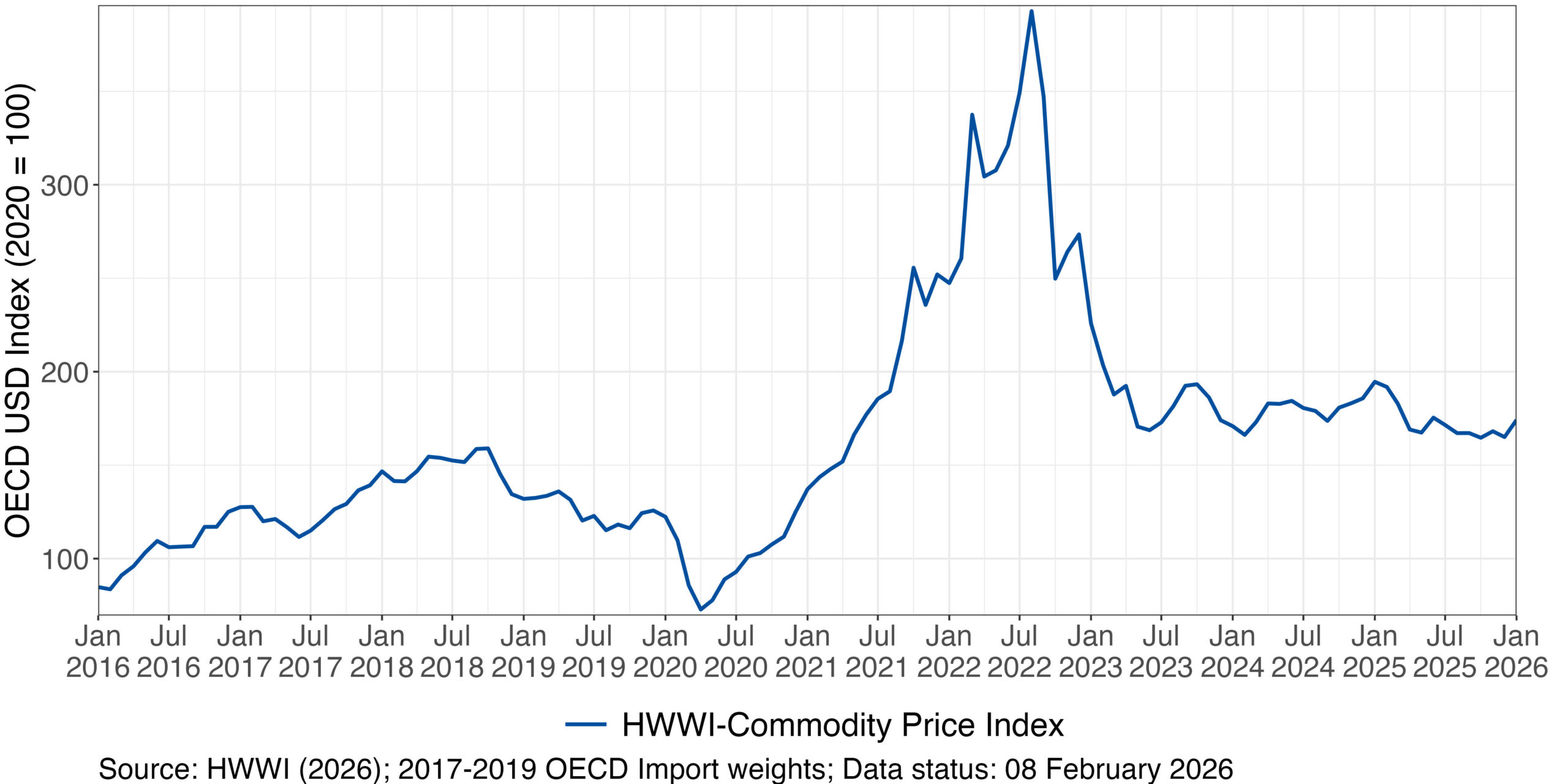
Over the past three months, the previously observed slight downward trend in the HWWI Commodity Price Index did not continue. Following an increase of 2.1 % in November and a decline of −1.8 % in December, the index rose markedly by 5.5 % in January 2026. Despite this monthly increase, the index at the end of January remained around 10.5 % below the level of the corresponding month of the previous year (data status: 08.02.2026).
The slight increase in November was primarily attributable to rising prices for energy commodities (+2.8 %). In December, however, prices for energy commodities declined moderately (−3.3 %), before recording a pronounced increase again in January (6.6 %). Compared with January 2025, the energy commodity index nevertheless remained around 15 % lower.
Prices for European natural gas showed a fluctuating pattern towards the end of 2025 and at the beginning of 2026. In November 2025, they declined by 5.1 % compared with the previous month. This development continued in December with a further decrease of 8.6 %. By contrast, prices increased by 26.7 % in January 2026. In year-on-year terms, prices for European natural gas were below the respective levels of the previous year throughout the entire period under review. The gap amounted to −25.1 % in November 2025, −31.3 % in December and −18.7 % in January 2026. Overall, despite the short-term counter-movement at the beginning of the year, price levels remained lower than in the previous year.
The food index displayed mixed monthly developments during the reporting period. In November, it initially rose by 0.4 % before declining in December (−1.7 %). In January, the index continued its downward trend and fell by −3.7 %. Overall, the index in January 2026 was therefore 20.3 % below the level of the previous year, 2025.
The development of the food index towards the end of 2025 and at the beginning of 2026 was largely shaped by price movements in cocoa. In November 2025, the cocoa price declined by 6.2 %. In December, this was followed by a temporary increase of 3.8 %, before another decline of 14.3 % was recorded in January 2026. Overall, the period under review showed a downward trajectory. Compared with the previous year, the cocoa price was 29.5 % lower in November, 44.2 % lower in December and 53.6 % lower in January 2026.
Coffee prices also showed movements over the same period. In November 2025, they rose slightly by 1.2 %, but then declined again in December (−7.7 %) and January (−2.5 %). In year-on-year terms, coffee prices were still 22.1 % higher in November, but increasingly approached the previous year’s level towards the end of the year and fell below it in January 2026 (−3.8 %).
The industrial raw materials index stagnated in November (0.4 %), but then recorded increases of 3.6 % and 7.1 % in December and January respectively. As a result, the index stood around 20.4 % above the level of the previous year. Copper prices showed an upward trend towards the end of 2025 and at the beginning of 2026. In November 2025, prices increased by 1.0 % compared with the previous month. This development continued in December with an increase of 9.5 %, followed by a further rise of 10.6 % in January 2026. In year-on-year terms, the copper price was 19.0 % higher in November 2025. This gap widened to 32.7 % in December and to 46.0 % in January 2026.
Tin prices showed a pronounced upward trend around the turn of the year. In November 2025, the price increased by 2.7 % compared with the previous month. In December, this was followed by a further increase of 12.0 %, which continued in January 2026 with a rise of 20.4 %. In year-on-year terms, the price gap increased continuously over the period under review. In November 2025, the tin price was 24.4 % above the level of the previous year, in December 43.8 % and in January 2026 68.7 %. Tin therefore exhibited a pronounced upward movement in both month-on-month and year-on-year comparisons.