



New HWWI Forecast
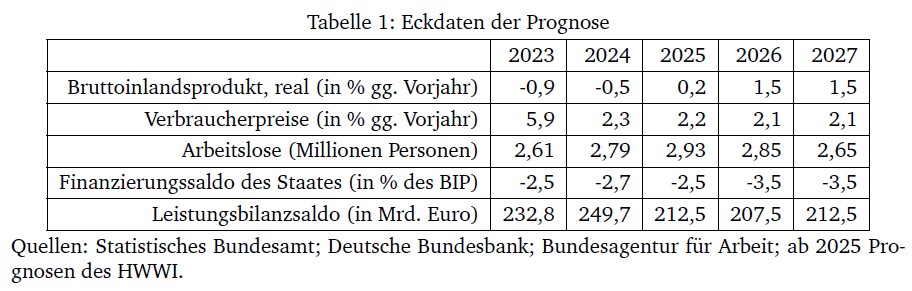
The German economy is waiting for the economic turnaround. As in the first half of 2025 overall, real gross domestic product stagnated in the 3rd quarter. A difficult international environment and a so far only tentative implementation of reforms by the new government – overshadowed by recurring disruptions within the coalition – continued to slow down economic development. However, following the settlement of the tariff issue with the USA and the gradual implementation of fiscal spending programmes and support measures, the economic climate should improve. This should be reflected in the corresponding statistics in the last months of this year, but especially from next year, especially in the case of investment in construction and equipment. Government and private consumption will also continue to support the economy. Only the balance of exports will have a negative effect with only weak exports and stronger growth in imports. For 2025, the HWWI continues to expect economic growth of 0.2% on an annual average. With increased economic momentum as a result of the fiscal programmes and support measures, economic growth of 1 1/2% is then expected for 2026 and 2027, especially as more working days (2026 a total of 2 1/2 more than in 2025, another 1 1/4 more in 2027).
The increase in consumer prices has been close to the stability mark of 2% for some time, but without falling below it in the long term. The core rate remains at around 2 3/4%, not least because wage settlements are generally above the inflation rate and thus also those of labour costs in the event of weak productivity development. This will probably keep the inflation rate just above the 2 percent mark in the forecast period.
The risks to this forecast are manifold. In addition to geopolitical tensions, the uncertainties caused by the U.S. tariff policy and China’s trade policy are weighing on international economic relations. Domestically, the pace of reform has so far been slow and there are increasing indications that the special debt possibilities are not only used for additional investments, but also for expenditure from the actual core budget; this reduces the possible growth impulses. In addition, the necessary reforms in the social security systems hold some explosive material for the coalition.
Press Contact

Contact

Prof. Dr. Michael Berlemann