



New HWWI Forecast
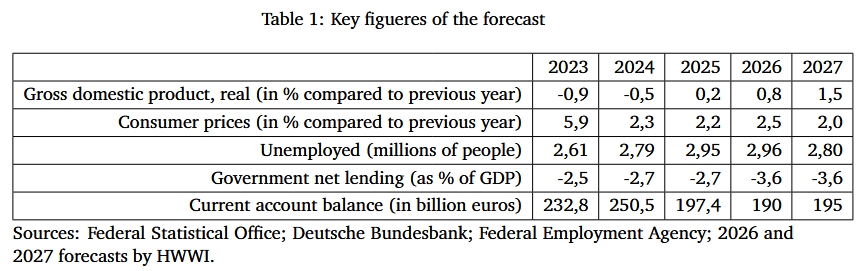
The German economy had stabilised towards the end of last year; many economic indicators developed positively. The growth opportunities for 2026 and 2027 were assessed favourably due to the fiscal spending programmes and support measures launched by the coalition government. However, with the Iran war and the resulting price shocks for oil and gas, the prospects for inflation and growth – not only in Germany, but worldwide – have initially deteriorated. The further development of the Iran conflict is unclear – here it is assumed that the war will be limited to the territory of Iran by the middle of the year at the latest and that the Strait of Hormuz will be freely passable again. Oil and gas prices would then move back towards pre-war levels. The recovery of the German economy, scheduled for 2026/2027, could then “pick up speed” again in the second half of this year. Under these conditions, the HWWI expects average annual economic growth of 3/4% for 2026 (before the outbreak of war: 1 1/2%) and one of 1 1/2% for 2027.
The inflation rate for consumer prices in Germany has recently hovered around the stability mark of 2%. This was not least due to low energy prices. Here the situation has now turned drastically. This will lead to a significant surge in inflation in the coming months; by the middle of this year, the inflation rate could rise to 3%. At the development assumed here, the inflation rate would move back towards 2% by the end of this year. On an annual average in 2026, it would then be 2 1/2%, and in 2027 it could reach 2% again.
The geopolitical and geoeconomic conditions pose significant risks to this forecast. The further development of the US-Iran conflict is unclear. In the event of escalation, such as major destruction of oil and gas facilities in the other Gulf states or a prolonged blockade of the Strait of Hormuz, the inflation forecast would have to be adjusted upwards and the growth forecast downwards. This makes it all the more important that the coalition government continues to push ahead with structural reforms and that the special debt opportunities are used exclusively for additional investments; a reallocation of expenditure from the actual core budget would reduce the possible growth impulses.
Press Contact

Contact

Prof. Dr. Michael Berlemann